Colour That Comes Back: A Motif Across the Frame
Track a recurring film colour through its changing placement and company to see how an image gathers meaning without turning colour into a fixed code.
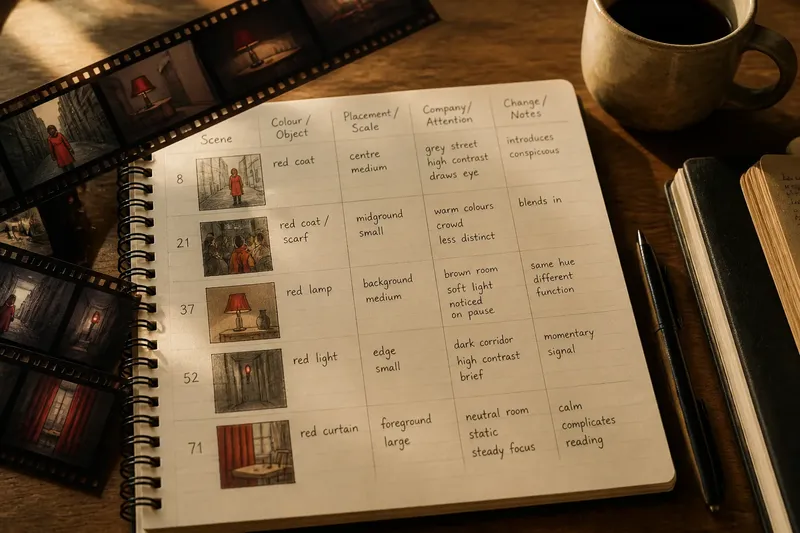
How do you tell whether a recurring colour is doing more than making a film look coherent? Follow where it appears, what shares the frame with it, and how those relationships change. A film colour motif is not a dictionary entry: red does not automatically mean danger, nor blue melancholy. Meaning gathers through particular images, then shifts as the film puts the colour to different uses.
The practical task is to trace those changes without deciding too early what they mean. A red coat might first be conspicuous against a grey street, later blend into a crowded room, and eventually appear as a small patch in a frame dominated by something else. The colour stays recognisable; its job does not have to.
Choose a colour to follow
Start with a viewing rather than a theory. Notice a colour that returns clearly enough to catch your attention, but do not assume that every object in that colour belongs to one designed pattern. A bright yellow taxi may be ordinary street furniture in one scene and an unusually emphatic shape in another.
Make a brief note of the first few appearances you remember. Record the colour, its object and the scene’s broad location: “green scarf, kitchen doorway” is more useful than “green means envy”. The first note should describe what is visible, not explain it.
Choose a colour with enough variation to trace. If a colour appears only once, it may still matter, but there is no recurrence to examine. If it seems to be everywhere, narrow your attention to one hue or one kind of appearance, such as reflected light rather than costume.
Film colour motif: log appearances
On a second viewing, pause after scenes where the colour stands out. A notebook or a simple document is enough. Keep each entry short so the record remains a map of the film, not a substitute for watching it.
- Placement: note whether the colour sits in the foreground, background, centre or edge of the frame.
- Scale: record whether it fills a large area or appears as a small detail.
- Object: identify what carries it, such as a lamp, dress, wall or reflection.
- Company: list the nearby colours, objects and people that shape its appearance.
- Attention: note whether lighting, focus, movement or contrast makes it easy to spot.
- Change: describe what has altered since its previous appearance.
Keep descriptions concrete. “A narrow orange strip behind the actor, softened by shadow” gives you something to compare; “orange signals warmth” skips straight to a verdict. If the colour is hard to distinguish, note that too. A motif can become less legible without disappearing.
Compare its company
Now look beyond the colour-bearing object. What sits beside it? A red scarf among neutral coats may be visually isolated; the same scarf among other warm colours may lose its special prominence. Neither arrangement carries a universal meaning. The comparison tells you how the film directs attention in that moment.
Look at framing as well as palette. A yellow window at the edge of a wide shot can make a room feel spatially different from a yellow face filling the frame. Ask whether the colour connects separate parts of the image, marks a boundary, or draws the eye away from an action. These are observations about composition, not yet claims about symbolism.
Say you notice a green plant in a character’s first two appearances: once beside a bright doorway, once in a dim room crowded with brown furniture. Later, imagine the film places a green plastic cup alone on a table after that plant has disappeared. You might note the shift from living foliage to an ordinary object, and from a busy setting to an isolated detail; whether that change suggests continuity, loss or simple visual echo depends on what the surrounding scenes support.
Track changes in placement
Arrange your notes in the order the film presents them. Look for changes in distance, position and visibility. A motif may move from background to foreground, from a personal object to a public sign, or from a broad field of colour to a small remnant. Such movement can alter how closely the image associates the colour with a character or event.
Check whether the colour appears at a turning point, but do not promote coincidence into a rule. A red light in two tense scenes might seem linked to danger; a later red curtain in an uneventful conversation complicates that reading. The useful question is not “What does red mean?” but “What does this appearance do here, and how does it relate to the others?”
Pay attention to absence. If the colour vanishes for a long stretch, that gap may change the force of its return. It may also reflect a change of location, wardrobe or lighting. Note the absence first; decide whether it carries expressive weight only after considering what else has changed.
Test a reading against scenes
Once you have a sequence of observations, draft a modest interpretation. Link it to specific placements and changes: “The film moves the pale blue from the character’s clothing to the empty space beside them, making their visual separation more noticeable.” This says what the image does without pretending the hue has a fixed translation.
Then challenge the reading. Find an appearance that does not fit. Does the colour turn up in a scene where your proposed meaning seems irrelevant? Does another visual feature explain its prominence more plainly, such as a light source or a repeated set design? A useful account can accommodate variation; it should not require every blue object to be a statement about sadness.
Distinguish a recurring colour from a recurring object. A red dress, a red exit sign and red light reflected on a wall may form a visual pattern, but they do not become interchangeable simply because they share a hue. Their materials, uses and positions matter. The motif may lie in the film’s repeated attention to that colour, while each appearance contributes a different association.
Questions about colour motifs?
Does every repeated colour count as a motif?
No. Repetition is a starting point, not proof of emphasis. Consider how prominently the colour is framed, whether its appearances change in a noticeable way, and whether the pattern helps explain the film’s visual choices.
How many appearances should I track?
There is no required count. Follow enough appearances to compare them, including at least one that complicates your first interpretation. A handful of carefully described moments is more useful than a catalogue of every coloured object.
Should I look up what a colour symbolises?
Begin with the film’s images, since general symbolic associations can make a viewer overlook local details. If you later consult a cultural or historical source, keep that information separate from what the framing itself shows.
What if the colour changes under different lighting?
Describe the appearance rather than forcing it into a precise label: “muted green in shadow” may be clearer than treating it as the same vivid green seen earlier. The shift in visibility can itself be part of the pattern, though it may also follow naturally from the scene’s light.
Write the image-based claim
For a short piece of criticism, select a few appearances that show a clear change in placement or company. Describe each image before interpreting it, then connect the moments with a sentence about what changes across them. Do not make the colour carry an argument that the scenes cannot support.
A strong account of a film colour motif leaves room for more than one association. It names the hue, the object carrying it, its position in the frame and the company it keeps, then explains how those details develop across the film. When a colour returns, check what has moved around it before deciding what has stayed the same.