Whose Face Holds the Scene? Ensemble and Lead Performances
Ensemble and lead performances distribute attention differently; learn to spot stalled character change and shifting focus without mistaking screen time for depth.

When a film’s ensemble and lead performances feel oddly out of balance, the useful question is not simply who gets the most screen time. Ask whose face holds a scene when something changes, and whether the rest of the cast has room to alter the story in response. That distinction can explain why a crowded drama feels alive, or why a star-centred film seems to leave its supporting characters waiting in the corridor.
Performance is part of the film’s distribution of attention. A lead may carry a clear change from guardedness to trust, while an ensemble lets that change emerge through several characters’ choices. Either arrangement can work. Problems arise when the film’s acting pattern promises one kind of story and delivers another.
Ensemble and lead performances
A lead-centred performance gives one character’s decisions and changing behaviour the main line of development. Other actors may challenge, shelter or expose that person, but the audience is generally invited to track the lead’s evolving response.
In an ensemble, attention circulates. Several characters have independent aims, and the meaning of a scene may depend on how their performances meet: one person hesitates, another takes advantage, a third refuses to smooth things over. The distinction is not a head count. A film with many speaking roles can still be built around one character, while a small cast can share the dramatic weight.
When reading either form, notice who changes the terms of an interaction, not just who begins it. A character who has little dialogue can still redirect a scene through a withheld answer or a sudden decision.
When the lead feels unsupported
A familiar problem is a central performance that seems to carry every important feeling alone. Supporting characters deliver information or sympathy, then disappear before their own behaviour can complicate the lead’s next choice. The lead may be skilled and vivid, yet the story’s emotional world feels thin.
This often comes from treating supporting roles as functions rather than people with competing intentions. If everyone around the lead exists only to approve, oppose or explain, their performances cannot create much friction. The film may then ask the lead to supply both personal change and the sense of a wider community.
Try tracing a scene through the supporting character’s objective. What does that person want before the lead enters, and what do they do once the lead asks for something? If the answer is always “help the lead”, look for moments when another actor’s resistance, tact or self-interest gives the central performance something specific to answer.
In criticism, describe the gap precisely: the lead’s reaction develops, while the surrounding roles remain fixed. That is more useful than saying the supporting cast is weak, which can confuse limited writing with limited acting.
When the ensemble feels scattered
An ensemble can have the opposite difficulty: several actors give convincing performances, but their character changes seem unrelated. A scene may offer a succession of strong impressions without building a shared dramatic movement. The viewer remembers individual moments but cannot tell what the group has become.
This can happen when characters receive introductions but not consequences. A sharp exchange establishes a personality; later scenes repeat the same trait without letting it affect a relationship or decision. Distinctiveness alone is not development. A character changes when an action, discovery or refusal alters what they can do next.
Try following one relationship rather than attempting to track every member of the cast at once. Note what each person expects from the other, then watch for a changed bargain: a confidence withheld, a favour returned, an alliance quietly abandoned. If that relationship shifts, it may supply the thread connecting otherwise separate performances.
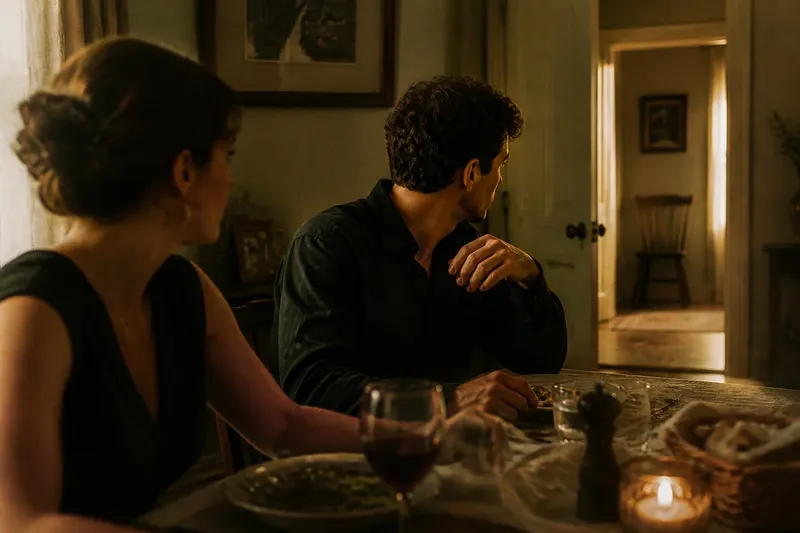
For a reviewer, the practical question is whether the group’s scenes accumulate. A dinner-table argument that leaves the family differently arranged has done more than display six separate temperaments.
When screen time misleads
Uneven screen time is easy to notice and easy to overinterpret. A character who appears briefly may make a consequential choice; a lead may be present throughout without changing much. Counting appearances is a poor substitute for asking how attention works.
Try separating duration from dramatic agency. Who makes a decision that closes off another possibility? Who is allowed to respond in a way that changes the next exchange? A brief performance can have strong agency if its action forces others to adjust, while a long-running role can remain largely reactive.
Also distinguish a character’s importance to the plot from the performance’s emotional weight. A messenger may deliver the information that starts the story but have little inner movement. A sibling who never controls the plot may still change the lead’s understanding of a shared past. The film can distribute these kinds of importance differently.
Imagine a fictional family drama in which the lead spends most of the story trying to sell a shop, while a quieter sibling appears only at family meetings. If that sibling finally refuses to sign the sale papers, the useful question is whether earlier scenes gave the refusal a legible source, such as a different attachment to the shop. The expected observable result of this reading is not a verdict about who “deserved” more screen time, but a clearer account of how a brief action alters the lead’s options.
When character change feels sudden
A turn can feel abrupt even when the plot has prepared it. The missing element may be performance: the actor’s behaviour has not made the pressure accumulating inside the character legible. Conversely, a tiny shift in gesture or timing can make a large decision feel earned without announcing it in advance.
Look for a sequence of changed responses rather than a single expressive signal. Does a character begin to answer questions more cautiously, interrupt someone they once indulged, or stop masking irritation? These are not rules for how an actor must play a role. They are observable choices that help a viewer track whether the character’s conduct is changing.
If a transformation seems to arrive from nowhere, return to the earlier scenes in which the character faced related pressures. Ask what they did then, what they do now, and what event makes the difference plausible. If the film offers no meaningful contrast, the issue may be in the writing or editing as much as in the performance.
When subtlety looks like sameness
Restrained acting can be mistaken for a static character, especially when a film avoids confessional dialogue and conspicuous emotional displays. But low volume is not, by itself, evidence of complexity. A composed performance still needs distinctions in attention, choice or response.
Try comparing the character’s behaviour with different people. Someone may be polite with a colleague, unusually patient with a child and guarded around a former friend. Those differences can disclose change without a speech explaining it. If every exchange carries the same tone and the character makes no consequential choices, “subtle” may simply be a generous word for unchanged.
Notice, too, whether other actors affect the performance. A responsive ensemble gives a performer something to take in: a delayed reply, a look of disbelief, a joke that lands badly. If the lead’s manner shifts only in moments designed to display emotion, the role may feel sealed off from its relationships.
When a star eclipses the cast
A recognisable lead can pull attention even when the film is trying to share it. This is not automatically a flaw. A story about isolation may benefit from keeping us close to one person. The problem is a mismatch: the film presents several characters as consequential, but scenes repeatedly return to the lead before their actions can register.
Watch how scenes end. Does the camera or edit leave room for another actor’s reaction, or does the lead’s response close every exchange? The performance itself matters here, but so do duration and scene construction. An actor can make space for a co-star by listening fully, or dominate a scene through interruption; the finished film decides which moments remain visible.
Try assessing whether supporting characters change the lead, not merely whether they attract attention. If their actions produce no adjustment in the central performance, the film may be keeping its focus too tightly fixed. If the lead’s behaviour shifts in response to them, a star-centred structure can still contain genuine interaction.
Questions about screen performances?
How can I tell whether a film has an ensemble cast?
Look for several characters with their own aims and consequential decisions, rather than relying on the number of actors in the credits. If the story’s direction changes through their interactions, attention is being shared even if one person remains the lead.
Can a lead performance be quiet and still carry a film?
Yes. A lead can anchor a story through small but changing responses, including what they accept, resist or leave unsaid. Quietness becomes limiting when it is not accompanied by discernible shifts or choices.
Why do supporting performances sometimes feel thin?
Some supporting roles are written mainly to prompt or explain the lead’s behaviour. Actors have less opportunity to create a sense of independent intention when scenes give their characters no aims or consequences of their own.
Does more screen time mean more character development?
No. Duration gives a character more chances to appear, not necessarily more chances to change. Look for altered decisions, relationships and responses instead.
Describe the distribution
A precise account of ensemble and lead performances names where attention goes and what that attention allows the characters to do. Instead of calling a cast “balanced”, identify which relationships alter the story, which performances remain steady, and whether that steadiness is purposeful.
When writing about a scene, begin with an observable change: who adjusts their behaviour after another person speaks, and what becomes possible or impossible as a result? That question keeps criticism close to the acting on screen rather than drifting into a ranking of performers. The most useful measure is not who owns the scene, but whether the film lets its characters affect one another.