The Unseen Listener: Point of View in a Film Scene
Point of view in a film scene shows how framing, reactions and withheld information steer attention, helping you see who knows what and when.
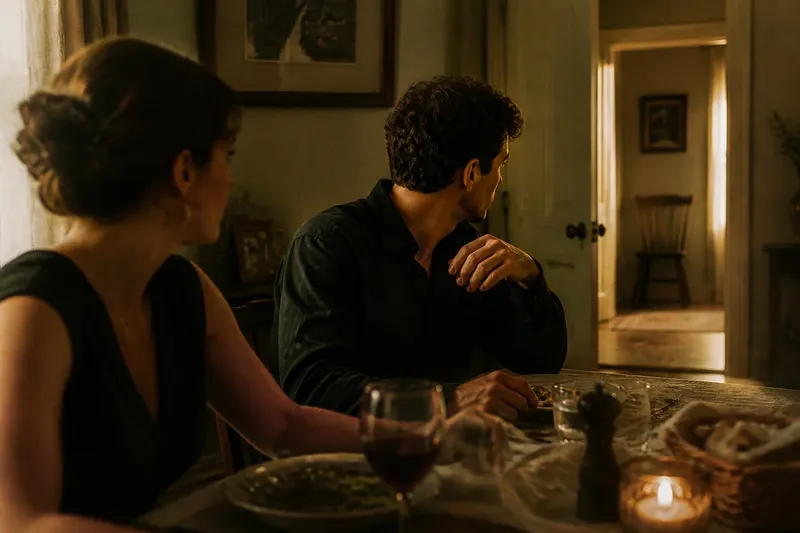
Who knows the door has opened before the character on screen turns around? Point of view in a film scene answers that question by arranging what we can see, hear and infer—and by keeping some things beyond our reach. It is less a matter of identifying a camera’s literal position than of noticing whose access to events the scene organises.
A scene can belong to a character without showing through that character’s eyes. It may stay close to their attention, follow what they hear, or let us know something they do not. Tracking those choices reveals how a film directs suspense, surprise and sympathy without needing to explain its intentions aloud.
Access and attention
Start with a simple distinction: access is what a character or viewer can know; attention is what the scene asks us to notice. A film can give us broad access while directing attention towards a small detail, or limit access so thoroughly that an ordinary sound becomes a warning.
Suppose a character studies a letter while another person waits outside the room. If the film shows the waiting figure before returning to the letter, we know more than the reader of it. If it stays on the page and lets us hear footsteps approach, the unseen arrival becomes our focus, though we do not yet know who is coming.
Neither arrangement is automatically more suspenseful. The effect depends on what the audience can reasonably infer and how long the scene makes us wait before confirming it. A shot can hold back an answer, but it cannot make a question matter unless something in the scene gives us reason to ask it.
Point of view in a film scene
The familiar point-of-view shot places the camera where a character might be looking: a face turns, then the film shows a window, a stranger or a moving object. The cut gives the next image a clear owner. But a scene’s point of view is usually broader than this single device.
A film can remain aligned with a character through framing, timing and sound while never adopting their exact eye-line. A corridor might be shown from behind them, with the camera close enough to share their limited view. If the framing excludes the far end, we may feel their uncertainty; if the camera looks down the whole corridor, the scene has granted us an advantage instead.
That advantage can be slight. We might see a hand pause at the edge of a frame before the character notices it. Or we may hear a chair scrape from an unseen room while the character continues speaking. The scene has not left its location, but it has widened our access beyond the visible action.
Ask, then, not only “Whose eyes are these?” but “Whose information is the scene using?” A close shot can still withhold what a character knows, and a distant view can still make us share their uncertainty. Camera position is evidence, not a complete verdict.
What reactions reveal
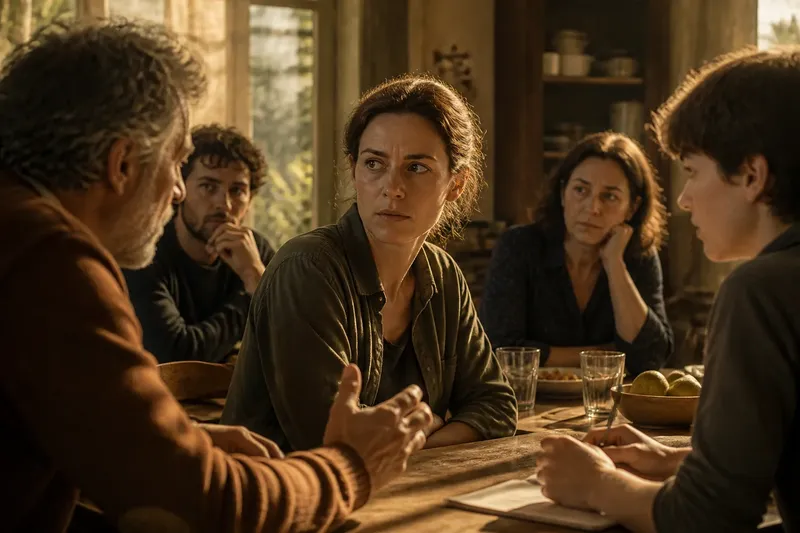
Reaction shots are one of the most direct ways a film assigns attention. A remark lands, and the scene cuts not to the speaker but to the person hearing it. That choice can make the response more important than the line: a tightened jaw, a delayed blink or no visible change may alter how the words register.
Showing a reaction also gives the viewer information about its owner, though not necessarily about what it means. A character may look alarmed because they recognise a name, because they are pretending to recognise it, or because someone else has entered the room. The performance supplies a clue; the scene’s arrangement determines how firmly we can connect it to a cause.
Imagine a dinner scene in which Mara asks a question and Eli looks towards the empty chair before answering. If the film cuts to that chair, we are invited to treat it as relevant, though we do not yet know why. If the film stays on Mara, Eli’s glance may pass as incidental; we register it only if another detail later gives it weight.
Notice who receives a reaction shot and who does not. When a film repeatedly returns to one listener, that character can become the scene’s centre of judgement, even if someone else speaks most. Conversely, withholding a response may keep a character unreadable or prevent us from settling on a single interpretation.
Knowledge before the cut?
How can I tell whose point of view a scene follows?
Track who sees, hears or recognises each important detail, then compare that with what the camera and soundtrack provide. If the viewer receives information a character lacks, the scene has widened access beyond that character, even if it remains visually close to them.
Does a point-of-view shot always belong to a character?
Usually, the surrounding action identifies a looker: a face turns, followed by what they see. Without that cue, an image may be an establishing view or an independent camera position rather than anyone’s literal sight.
Why show a listener instead of the speaker?
A listener’s expression can reveal how a line lands and shift attention from what is said to what is understood or concealed. It may also leave the response ambiguous, especially when the scene cuts away before the listener acts.
What does an off-screen sound contribute?
It gives the viewer evidence without supplying an image, so we must decide whether the sound belongs to the scene’s current focus or threatens to redirect it. Its source can remain unknown, or become clear through a later look, movement or cut.
Off-screen space
The area outside the frame is not simply absent. Characters may look towards it, address someone in it, or react to an event we cannot see. Those gestures give the unseen space shape while leaving its contents open to doubt.
Listen for how sound handles that boundary. A voice from another room can tell us where someone is without showing them; a noise with no obvious source can make the location feel larger and less knowable. The viewer’s access depends on what the sound clarifies: its direction, its source, its timing, or perhaps only the fact that something has happened.
Off-screen space can also preserve a character’s limited knowledge. If someone faces away from a doorway, the audience may see an entrance they miss. If the camera stays with their face and the sound gives no clear warning, we may share their surprise instead. The difference is not merely what remains unseen, but whether the viewer has been allowed to anticipate it.
When a film finally reveals an off-screen source, look back at what the scene had already established. A glance or interrupted sentence may have made the reveal feel earned; a sound without a usable cue may have kept the source deliberately indeterminate. Both choices can work, but they invite different kinds of attention.
When the alignment shifts
Scenes can change point of view without announcing the change. A conversation may begin with the camera held near one character, then move to a wider position as a third person enters. That shift can reduce our closeness to the first character, make the newcomer’s presence newly legible, or give the whole group a shared space.
Sound can create a similar shift. At first we may hear a room as one character does: a muffled conversation through a wall, with only fragments clear. When the film moves into the room, the voices become distinct and the scene’s knowledge changes. The transition tells us not merely that we have changed location, but that we now have access to information previously withheld.
Changes need not settle the meaning. A film may offer one character’s interpretation of an event, then show another person’s reaction without confirming which account is true. That arrangement separates access from certainty: we know more about what each person claims, but not necessarily more about what happened.
For a useful reading, mark the moment your knowledge changes. What new image, sound or reaction supplied it? Did the scene confirm an earlier suspicion, correct it or leave several explanations alive? This keeps analysis tied to what is actually presented rather than to a guess about what the film “must mean”.
Reading a scene closely
Choose a short exchange and follow it in order. Pause at each cut, or replay it without sound and then with sound, noting what changes when one channel is removed. This is not a test of technical vocabulary; it is a way to separate what the image gives from what dialogue and sound add.
- Identify the initial focus. Which person, object or action receives the first sustained attention?
- Track knowledge. Note what each character appears to know and what the viewer learns independently.
- Watch the listeners. Notice whose reactions are shown, delayed or omitted after a line or event.
- Map the frame’s edges. Record where looks, voices and noises point beyond the visible area.
- Locate each change. Ask which cut, sound or movement altered your understanding, and what it left uncertain.
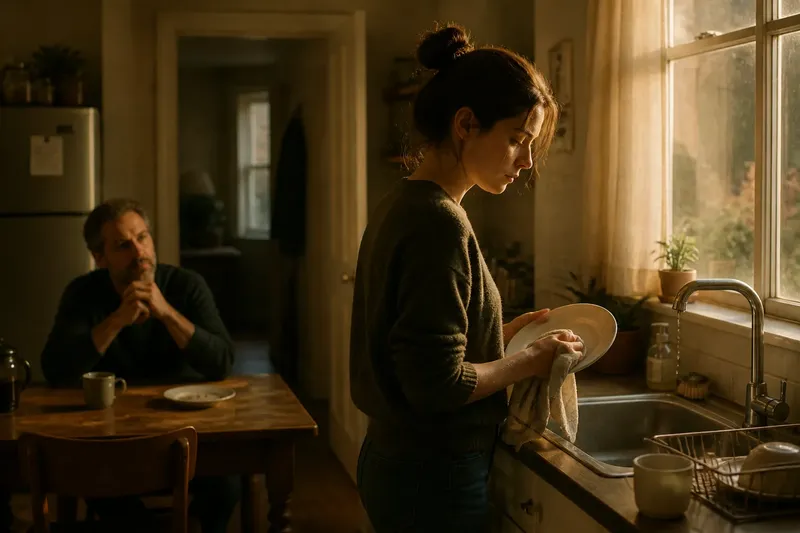
Imagine you are watching a two-person exchange in a kitchen. One person asks where a key has gone; the camera cuts to the other person’s hand beneath the table, but the first speaker keeps talking. You now know the key is being concealed, while the speaker does not; if the film cuts away before the hand is withdrawn, you also have reason to watch for whether the concealment is discovered.
The scene’s point of view lies in that precise imbalance: what the viewer knows, what each character knows, and which details the film chooses to make visible. In the next scene you watch, note the first moment your knowledge gets ahead of a character’s—or falls behind it. That small gap is often where the storytelling starts to work on you.