The Programme Note Is Not the Film: Using Context Without Letting It Lead
Use film context without letting it lead: a week-long viewing routine keeps historical information in view while returning attention to choices on screen.
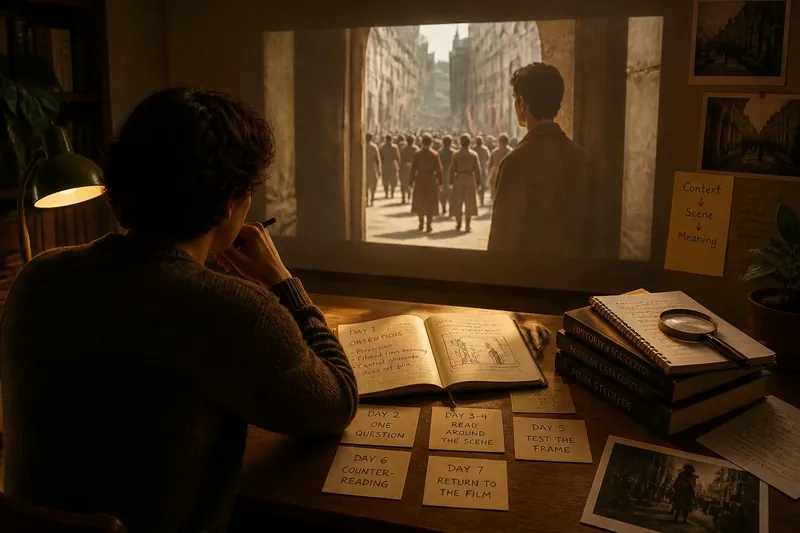
Film context can clarify what a scene risks, assumes or leaves unsaid, but a programme note can also arrive so confidently that the film seems to become its illustration. A week-long routine for reading context keeps the historical frame available while returning attention to what the film actually presents: its choices of action, framing, duration and emphasis.
Begin with the screening
On the day you watch the film, put the programme note, director’s statement and review aside. Watch without pausing to search names or settle questions about the period. The aim is not to pretend the film has no history; it is to notice what it gives you before somebody else supplies a preferred explanation.
Afterwards, write a short record in plain terms. Note the scene or choice that stayed with you, what you could see or hear, and what remains uncertain. “The procession is filmed from behind a doorway; the central character does not join it” is more useful at this stage than “the film rejects tradition”. The first records an observable arrangement; the second already interprets it.
Keep the record somewhere separate from your later notes. It gives you a point of comparison, not a verdict to defend.
Choose one question
The next day, turn one uncertainty into a question that context might answer. It should be narrow enough to investigate and connected to a particular moment: what public ritual is depicted, what restriction shapes a character’s options, or what a period-specific object would have signalled to its first audience?
A question such as “What was society like then?” has no useful stopping point. “Why does the clerk refuse to stamp this document?” gives you a scene, an action and a plausible line of enquiry. Context works best when it addresses a pressure the film has made visible, rather than providing a general atmosphere of historical seriousness.
Write the question before opening your sources. This small delay helps prevent the first available explanation from quietly becoming the question itself.
Read around the scene
On the third or fourth day, consult sources suited to the question: a museum catalogue for an object, a reliable historical account for a rule or institution, or the programme note for the production’s stated context. A review may explain how a film was received, but it is not automatically evidence for how the depicted society worked.
Separate three kinds of material in your notes:
- Contextual claim: what a source says about the period, place or cultural practice.
- Production claim: what the filmmakers say they intended or consulted.
- Film evidence: what the finished scene shows, withholds or makes difficult to interpret.
These categories can inform one another, but they are not interchangeable. A director’s stated intention may explain a choice without exhausting its meaning; a historical source may establish a rule without proving that every character would respond to it in the same way.
Check the label, maker’s notes or local guidance where the meaning of a source depends on its provenance or on a particular community’s account. If that point cannot be established, keep the uncertainty visible rather than smoothing it into a confident sentence.
Test the frame
Halfway through the week, return to the scene or sequence that prompted your question. Watch it again, this time asking what the new information changes and what it does not. Notice who acts, who waits, where the camera places the viewer, and which consequences the film allows to remain unresolved.
Say you first read the clerk’s refusal as personal spite. You then learn that the document concerns a rule restricting who may travel. On a second viewing, the refusal may look less like private hostility and more like the enforcement of an institution; the clerk’s pause, tone or glance may still suggest a personal choice within that system. The context changes the stakes, but the scene’s performance and arrangement still matter.
Try one counter-reading as well. If the context seems to explain the scene completely, ask whether the film’s details support that claim or whether they complicate it. This is not a demand to find hidden symbolism in every prop. Sometimes an object is simply there, which can be a relief.
What can context establish?
Does context explain what a film means?
It can make a choice more legible by identifying the pressures or conventions around it. Meaning still depends on how the film stages that choice and on which details it leaves open.
How should a programme note be treated?
Read it as a useful account of the film’s framing, not as a final ruling on every scene. Compare its claims with the finished film and, where relevant, independent material about the history it describes.
What if sources disagree?
Record the disagreement and ask whether the competing accounts concern different groups, places or periods. If the distinction cannot be resolved, make it part of the uncertainty rather than choosing the tidiest version.
When is there enough context?
Stop when the original question has a credible answer or when further reading no longer changes how you understand the scene. More background can add information without adding insight.
Return to the film
On the final day, write one compact paragraph with three parts: the relevant contextual point, the scene detail it helps you notice, and what the film still leaves unsettled. Keep each part distinct. “The rule limited travel; the clerk’s desk makes its enforcement visible; the film does not tell us whether he could have acted differently” is clearer than claiming the scene simply condemns a whole society.
Then review your first-day notes. If your description has changed, identify the exact new information that changed it. If it has not, that is not a failure: context may confirm the limits of what the film shows without giving you a new interpretation.
This routine is useful because it gives context a specific job. A programme note can sharpen attention, correct a mistaken assumption or point towards a worthwhile question; it should not replace the evidence of the film with a ready-made account. For film context, the most dependable habit is to return, after every explanation, to the scene that made you ask in the first place.